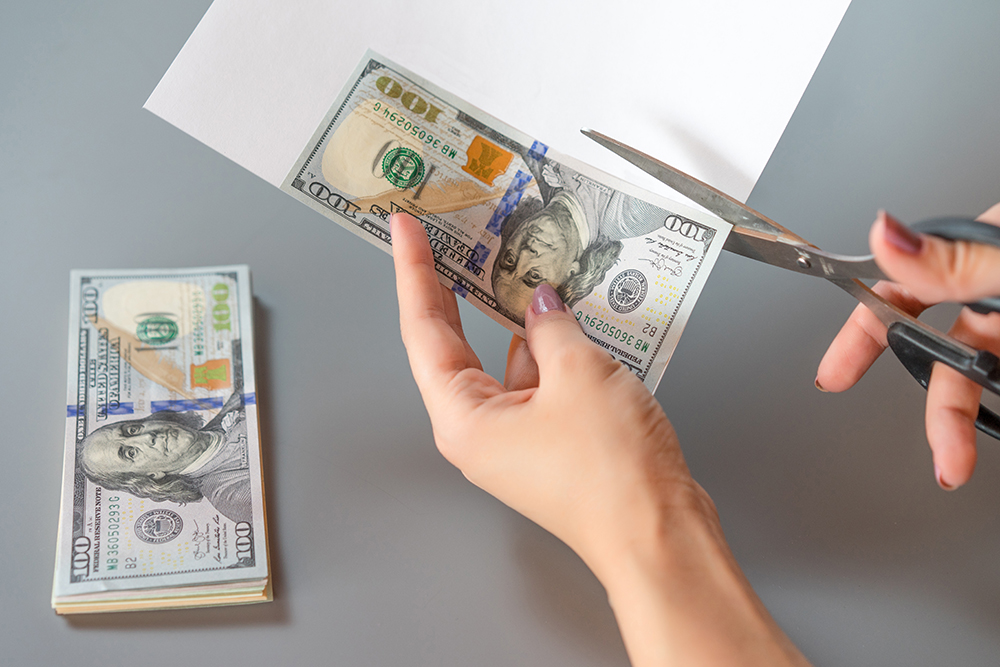


When retailers accept fake bills, they bear the entire burden of the loss. Although counterfeiters’ techniques are improving, the bad bills can be detected. Here’s how to spot counterfeit money and protect your business from related losses.
Counterfeit money is an ongoing threat retailers can’t afford to be complacent about. During the first three months of 2021, U.S. Customs and Border Protection officers seized $1.6 million in counterfeit currency in Chicago, Illinois. Another $110,000 in fake currency was seized in California.
Unfortunately for businesses, not all counterfeit bills are found and seized before getting into distribution. And when a business accepts fake money in payment for merchandise or services, they lose the face value of the money they received plus any goods or services they provided to the customer who paid with the counterfeit $20, $50, or $100 bill.
Fake money shows up in different states in different denominations at different times. Oftentimes, business owners don’t take notice of the bills because the purchases are minimal and the counterfeit money denominations are so small.
In one case, the Connecticut Better Business Bureau (BBB) was alerted to a $100 counterfeit bill that had been passed to an unidentified retailer in Southeastern Connecticut. According to the Connecticut BBB, the phony bill began as a legitimate $5 banknote.
“The counterfeiters apparently used a technique that involves bleaching legitimate money and altering the bills to look like $100 notes,” the BBB stated in an announcement. “Many businesses use special pens to detect counterfeit currency; however, the pens cannot give a definitive confirmation about suspected altered currency, and they are not sanctioned by the U.S. Treasury.”
Large bills like $100 and $50 bills aren’t the only ones that are counterfeited, either. In December, 2019, U.S. officials seized close to $1 million in counterfeited one dollar bills.
RELATED: Learn to Spot Fake Cashier’s Checks
How to Spot Counterfeit Money
Business owners can train their employees to examine all bills they receive, $10 and higher. If they believe they are being given counterfeit money, they can call the police.
Small business owners need to be aware of the many ways to detect counterfeit money. The Secret Service offers a downloadable PDF called Know Your Money that points out key features to look at to determine if a bill is real or fake. The Secret Service and U.S. Treasury also offer these suggestions:
- Hold a bill up to a light and look for a hologram showing an image that matches the face of the individual on the bill. Both images should match. If someone has bleached and altered a $5 bill to look like a $100 bill, for instance, the hologram will display an image of Abraham Lincoln, who appears on the $5 bills, instead of Benjamin Franklin.
- Looking at the bill through a light will also reveal a thin vertical strip containing text that spells out the bill’s denomination.
- Color-shifting ink: If you hold a new series bill (except the $5 note) and tilt it back and forth, observe the numeral in the lower right-hand corner as its color shifts from green to black and back.
- Watermark: Hold the bill up to a light to view the watermark in an unprinted space to the right of the portrait. The watermark can be seen from both sides of the bill since it is not printed on the bill but is imbedded in the paper.
- Security Thread: Hold the bill up to a light to view the security thread. You will see a thin embedded strip running from top to bottom on the face of a banknote. In the $10 and $50, the security strip is located to the right of the portrait, and in the $5, $20, and $100, it’s located just to the left of the portrait.
- Ultraviolet Glow: If the bill is held up to an ultraviolet light, the $5 bill glows blue; the $10 bill glows orange; the $20 bill glows green; the $50 bill glows yellow; and the $100 bill glows red — if they are authentic.
- Microprinting: There are minute microprinting on the security threads: the $5 bill has “USA FIVE” written on the thread; the $10 bill has “USA TEN” written on the thread; the $20 bill has “USA TWENTY” written on the thread; the $50 bill has “USA 50” written on the thread; and the $100 bill has the words “USA 100” written on the security thread. Microprinting can be found around the portrait as well as on the security threads.
- Fine Line Printing Patterns: Very fine lines have been added behind the portrait and on the reverse side scene to make it harder to reproduce.
- Comparison: Compare the feel and texture of the paper with other bills you know are authentic.
Know what to do if you suspect fake bills
If you believe you have received counterfeit money, the U.S. Treasury advises you to do the following:
- Do not put yourself in danger.
- Observe the passer’s description — and their companions’ descriptions — and write down their vehicle license plate numbers if you can.
- Contact your local police department or call your local Secret Service office.
- Do not handle the counterfeit note. Place it inside a protective cover, a plastic bag, or envelope to protect it until you place it in the hands of an identified Secret Service Special Agent. You can also mail it to your nearest Secret Service office.
Remember, if you are passed a counterfeit bill, you own it. So when accepting cash, it pays to be knowledgeable about the crime of counterfeiting.
Disclaimer: The content on this page is for informational purposes only, and does not constitute legal, tax, or accounting advice. If you have specific questions about any of these topics, seek the counsel of a licensed professional.
RELATED: Protect Yourself and Your Business From Identity Theft
Start an LLC in Your State
When it comes to compliance, costs, and other factors, these are popular states for forming an LLC.
-
 How To Start an LLC in California
 -
 How To Start an LLC in Florida
 -
 How To Start an LLC in Texas
 -
 How To Start an LLC in Colorado
 -
 How To Start an LLC in Michigan
 -
 How To Start an LLC in New York
 -
 How To Start an LLC in Ohio
 -
 How To Start an LLC in North Carolina
 -
 How To Start an LLC in Nevada
 -
 How To Start an LLC in Illinois
 -
 How To Start an LLC in Delaware
 -
 How To Start an LLC in Alabama
 -
 How To Start an LLC in Alaska
 -
 How To Start an LLC in Arizona
 -
 How To Start an LLC in Arkansas
 -
 How To Start an LLC in Connecticut
 -
 How To Start an LLC in Georgia
 -
 How To Start an LLC in Hawaii
 -
 How To Start an LLC in Idaho
 -
 How To Start an LLC in Indiana
 -
 How To Start an LLC in Iowa
 -
 How To Start an LLC in Kansas
 -
 How To Start an LLC in Kentucky
 -
 How To Start an LLC in Louisiana
 -
 How To Start an LLC in Maine
 -
 How To Start an LLC in Maryland
 -
 How To Start an LLC in Massachusetts
 -
 How To Start an LLC in Minnesota
 -
 How To Start an LLC in Mississippi
 -
 How To Start an LLC in Missouri
 -
 How To Start an LLC in Montana
 -
 How To Start an LLC in Nebraska
 -
 How To Start an LLC in New Hampshire
 -
 How To Start an LLC in New Jersey
 -
 How To Start an LLC in New Mexico
 -
 How To Start an LLC in North Dakota
 -
 How To Start an LLC in Oklahoma
 -
 How To Start an LLC in Oregon
 -
 How To Start an LLC in Pennsylvania
 -
 How To Start an LLC in Rhode Island
 -
 How To Start an LLC in South Carolina
 -
 How To Start an LLC in South Dakota
 -
 How To Start an LLC in Tennessee
 -
 How To Start an LLC in Utah
 -
 How To Start an LLC in Vermont
 -
 How To Start an LLC in Virginia
 -
 How To Start an LLC in Washington
 -
 How To Start an LLC in West Virginia
 -
 How To Start an LLC in Wisconsin
 -
 How To Start an LLC in Wyoming